While AI fast assumes the roles of both creator and critic, human creativity bleeds with endless infighting and self-doubt, oblivious to the potential demise of individual styles and creative instinct.
Purview
Humans have a penchant to create disasters and then attempt to cure them. Such persistent endeavours over centuries have involved more money, jobs, diplomacy, and resource mobilisation than anything worthwhile we have ever created. We do it to nature, wantonly engaging in its destruction and then launching conservation programs. We do it with science, inventing more and more ways to endanger humanity and then sitting down for peace talks and signing accords. We do it to our bodies, stuffing them with junk and stress and then looking for wellness retreats. We have finally done it to our minds.
With barely an idea about how the brain in its entirety functions as an instrument for intelligence, we decided to replicate its intelligence artificially. Great! If only the grand endeavour was for earning doctorates or creating reliable alternatives in data science, commercial operations, and scientific advancements. We went further and messed with perhaps the only original and non-lethal aspect of human intelligence – creativity. Now some people find creativity in making a gun out of a pipe or successfully pulling a financial scam. In the purview of this piece, creativity strictly refers to visual, literary, and performing arts. Let us see how Generative AI, which is giving heartburn to millions of writers and artists worldwide, got around to this mischief and how we might be playing out the script exactly as it wants.
Context
For those who see AI as a recent menace, the quest to create ‘thinking’ machines that could mimic human cognitive behaviour goes back to the 1950s when Alan Turing proposed his famous Turing Test or ‘The Imitation Game.’ The movie that goes by the same name is more about Turing’s pathbreaking work in codebreaking during WWII. In 2015, when I watched Benedict Cumberbatch’s brilliant performance in the film, I had no idea modern techies have brought Turing’s work so far that soon my laptop would be ‘writing’ instead of just being ‘written on.’
It might deepen wounds in the writing community, but majority of initial work on developing AI seemed to be about generating ‘human-like’ text. The first public chatbot ELIZA, launched in 1966 aimed to mimic a human psychotherapist analysing keywords in queries to provide pre-scripted responses. Great many advances were made in the field of AI since Turing’s work pertaining to speech recognition, data analysis, visual perception, and industrial automation, but it never came to bother the creative community since it never really got out of educational or commercial establishments and research facilities. Then something happened at a pub in Canada in 2014.
Disruption
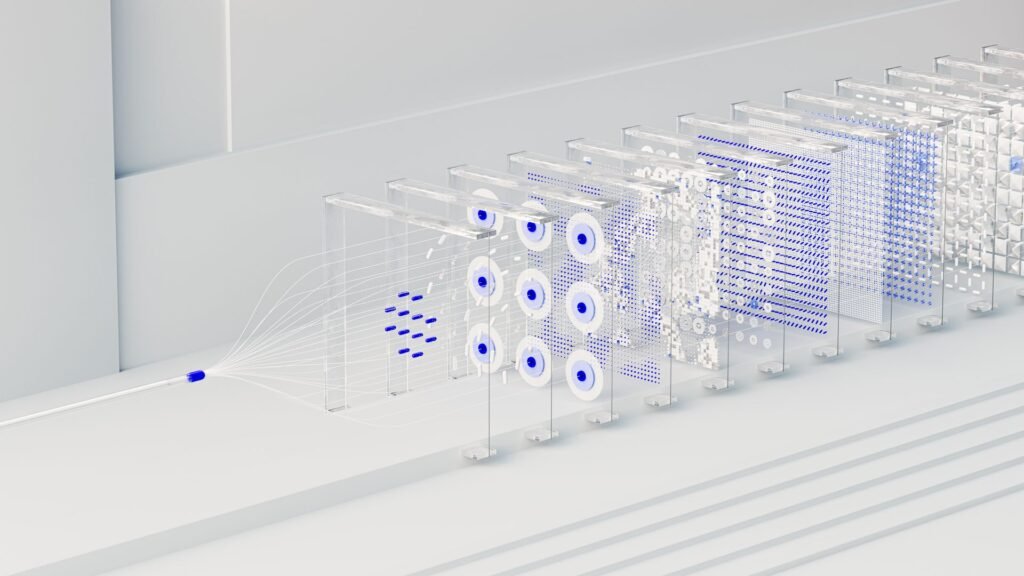
In the summer of 2014, Ian Goodfellow, a PhD student at the Université de Montréal, went pubbing with his colleagues and started discussing work. They were facing challenges in making machines generate more realistic images. I would love to know what they drank because it led to something more stupefying than a stupor. Mr Goodfellow had a lightbulb moment and went home to marry two machine learning neural networks who had the most contrasting objectives in life – a generator and a discriminator. The union gave birth to the Generative Adversarial Network (GAN), the soul of modern Generative AI. Essentially a generator neural network generates or creates something (say an image), and a discriminator neural network tries to distinguish or critique it for realism. Initially the two were separate entities working independently like carefree singles. Their wedlock in GAN made their interactions continuous and spontaneous.
Now the moment the generator creates something, the discriminator critiques. The generator learns instantly from the discriminator’s objections and tries to improve on its creation. The discriminator spontaneously learns from the new creation to become better at detecting a fake and raises new objections. The two keep getting better at outwitting each other like a married couple at loggerheads till a certain compromise is achieved and this happens at a typical speed of 100 such interactions per second! The result — hyper-realistic AI voice, text, images, and videos that are only getting better by the day.
The reason I am tormenting you with these analogies is that we need to know what we are up against before we start competing with it for the tag of originality. There is something poetically mortifying about this arrangement as this may be one of the greatest disruptions Generative AI poses to individual creativity. As humans we have always created and critiqued, but these activities are performed by separate individuals as creators and experienced reviewers, or mentee and mentors, to effectuate substantial progress in either the output or the capabilities of a creator. Now consider morphing into a GAN and doing self-critiquing. The concept is not new; we all do that. AI lost out on originality there, but then as humans we are all limited by our own notions, knowledge and imperfections.
A writer is rarely happy with the first draft. An artist often steps away from the canvas to reflect. A musician listens to rehearsal recordings primarily for distortions. We rethink, revise, delete, and recreate until we cannot find something to dislike about our work, or our mind is no longer capable of improving on it at that moment. A cup of coffee later, we may get back to refining or realise that a previous version was better. We are limited by our observations, skills, inclinations, preferences, and sheer physical and mental stamina. The machine does the same job ruthlessly. Generative AI has the creator and the critic working in tandem at a scale and speed that no human can match. Add to it the fact that we can critique ourselves endlessly and yet not really improve beyond a point. The machine gets better each time it goes through that cycle.
So, before we start pointing fingers at each other for the sake or lack of originality, we must understand the might of Generative AI in the war of moral conduct it has started within the creative community. Maybe then, the concern for many of us would shift from professional ethics to sheer survival.
Dilemma
Fast-evolving modern Generative Adversarial Networks are looping in auxiliary neural networks for better stylisation, consistency and realism in their creations. Simultaneously, humans are becoming increasingly less capable of telling them apart from our own work. Our ability to distinguish between the two is being challenged by the same technology that started creating the so-called fakes. Why would it abandon its purpose now? That has led us to a rather strange arrangement. We are asking AI systems to identify whether something was created by AI. We are asking algorithms to detect fingerprints of algorithms that are continuously evolving to wipe them clean. In a class on psychology and human behavioural anomalies, this is perhaps the most contemporary and glowing example of circular reassurance. We are seeking comfort in a repetitive loop since we have no way to address the root cause of the problem.
We are asking an accused to testify against itself. The only moral ground to accept the testimony is our fragile hope that the accused is not trying to fool us. That hope has already started to fade as people are getting increasingly wary of AI bypassing coded restrictions and developing its own agendas. However, governments, territories, resources, or information archives might all see their saviours rise to occasion. Human creativity has no such patronage. There would be no firewalls protecting a person’s imagination. No creative instinct would be protected like a national resource. There would be no task force going after an algorithm that declares a piece of creativity original or artificial based on some arbitrary criteria or collusion and we would trust it because we have no way of knowing better.
We torment ourselves questioning the authenticity of a piece of writing and the ethical standards of the person who wrote it. We question the speed at which things get written or their syntax, vocabulary, and punctuation. We trash a human and trust a machine to tell us whether another machine was in cahoots and amidst that debate the biggest irony is that we forget that the writer wrote it neither for other writers nor an AI agent. The human being who might actually read that piece – the reader – does not feature in our viewfinders.
Jeopardy
There are people who regard creativity as some sort of genetic privilege. Apparently, they can perceive the presence of that DNA in themselves overwhelmingly, and rarely its traces in a few others. I am not trying to create any stereotypes here. The point is with freedom of speech and expression comes the freedom to write. During my career spanning over three decades in various forms of creative and academic writing, I have come across a very diversified set of wordsmiths. Some spontaneous and some very methodical. Some prolific and some very scarce. Some who pay for a quiet getaway to write (eyeroll and a smile) … and some who could write in a boisterous fish market sitting in the dust. I am just trying to establish the premise that nobody can hand down a verdict on someone else’s capability or capacity to write about anything under the sun, let alone an AI agent to pronounce its authenticity. This newfangled moral policing within the creative community is becoming a fad. The fact remains it is just an old anomaly that has been reinvented at an unprecedented scale.
In the long run of human imagination, original creativity has always been dwarfed in terms of economics and volumes by fakes. Ghostwriters and art forgers have always been around driven by the needs of people lacking in creative pursuits but abundant in money and a desire for status and fame. Publishers and literary agents are more interested in your social media following than your ability to write to offer you a contract. Anybody could write, not everybody could sell. However, such privileges came at a bill not everybody could foot. That is where Generative AI has caused the biggest uproar. It has rendered such an essence of socialism to the availability of resources to create that we find it unbearable to handle it democratically. There was never such a strong demand for completely unadulterated, authentic attribution of human authorship to enjoy a piece of writing. Now forensic examination of the process is becoming more important than the product.
Do we wonder what the reader wants? If a reader comes looking to find insights into an unfamiliar topic, a solution to a problem, a useful recommendation, or just a good story, how much would the person care whether it was written by a human sitting at a desk or by an AI system operating from a server submerged in seawater somewhere. The answers might vary. Authentication and originality of authorship matter in intellectual property, attribution, consent, and citations. However, it is very presumptuous to assume that a reader’s search for useful information would always be an investigation into the genealogy of a resource.
You can choose to employ or dismiss Generative AI. You cannot expect the whole world to agree with you. It is just a piece of technology, and not the first time for a piece of technology to be devilised in the name of original art. Initially the printing press was condemned as a mechanical intruder into the respectable world of handwritten books. In 1472, scribes in Genoa filed a formal complaint with the authorities to seek restrictions on printed books in markets traditionally served by scribes. Photography had its own creativity crisis. In 1859, Charles Baudelaire opined that photography was a humble handmaid to the arts. He viewed that the machine could only reproduce what the eye saw; what could it possibly have to do with imagination? When Edison demonstrated his phonograph to Arthur Sullivan in 1888, the composer was ‘astonished and somewhat terrified’ that ‘so much hideous and bad music’ could be preserved forever. The same technologies have now become indispensable for creation, conservation, and propagation of art. I am not advocating the use of Generative AI. I am simply asking people to stop putting it on a pedestal as something to be feared or revered.
Perhaps our energies as writers and creators would be better spent doing what we are actually good at, creating more meaningful content for the reader who is never going to be replaced by an AI agent. Generative AI or any AI agent in any incarnation will never come looking for something we have written to like or comment on it. AI will simply add to the existing pile of content for anyone who is willing to use its services and then leave us to point fingers at each other and go hopping mad with anger and frustration.
Doomsday
What I find more disturbing than some people using Generative AI to produce mediocre poetry, synthetic photographs or perfectly competent prose, is the possibility of writers starting to condition their personal styles of rendering to avoid making them look like machine outputs.
Once we manage to rile up enough unrest for writers to become sufficiently obsessed with the so-called telltale signs of AI-generated writing, the damage may become consistent and irreversible. If all writers start scrutinizing their individual styles for anything that sounds too symmetrical, predictable or checks some boxes in some confounded evolving checklist of what supposedly seems AI-generated, writing will automatically stop being human.
Not all writers know they have a style and I am not a big fan of branding literary styles, but it is just the way people think and express their thoughts. At times, people spend a lifetime without perfecting or attaining a definitive, predictable way to say things in a characteristic stylised manner. I am still struggling to find mine. If a writer is able to find a unique voice, it is a remarkable achievement that needs to be treasured. A writer’s style is an accumulation of individual influences, rhythms, preferences, and peculiarities. That is what makes writings on the same subject by different people seem diverse and refreshing. Some use short sentences while some like their full stops fairly distant from each other. Some like me cannot resist dashes, semicolons and ellipses as the comma is not always enough. Some have a fondness for obscure terms while some master the art of instilling profoundness in simple words. These variations cannot be programmed as some guidelines or standards to ‘authenticate’ a piece of writing. That would be the very antithesis of creativity.
Imagine sanding away every characteristic that an AI Detector flags as AI generated writing. If all writers around the world consciously start trying not to sound like AI, it is just a matter of time before they could end up sounding like each other. We could spend years canvassing for protection of original human creativity from AI, but the moment we stop writing in our own styles for our readers and start catering to the fancies of an AI Detector, we step on a one-way street to homogenised mediocrity. AI may not undermine original human creativity, but we may definitely destroy it by stifling its diversity with our growing obsession to make everything sound too human. That would be truly catastrophic.
The idea of the writing community lapsing into some peculiar sort of literary conformity is not as far-fetched as it sounds. It is very probable that not too far in future someone might be browsing through a digital library tapping on and rejecting one book after another murmuring, “Human… human…human… another human… they all sound the same. Is there anything new from an AI Bot?” Generative AI would love that.
If this resonated, you may also like…
Entropy of Ethical AI
The Emotional Investment Portfolio
All writings in Inklings are original works by Amit Pandey and remain with the author. Please do not reproduce complete posts or substantial portions without permission. Short quotations are welcome with attribution. For online references, please include:
© Amit Pandey. All rights reserved.
