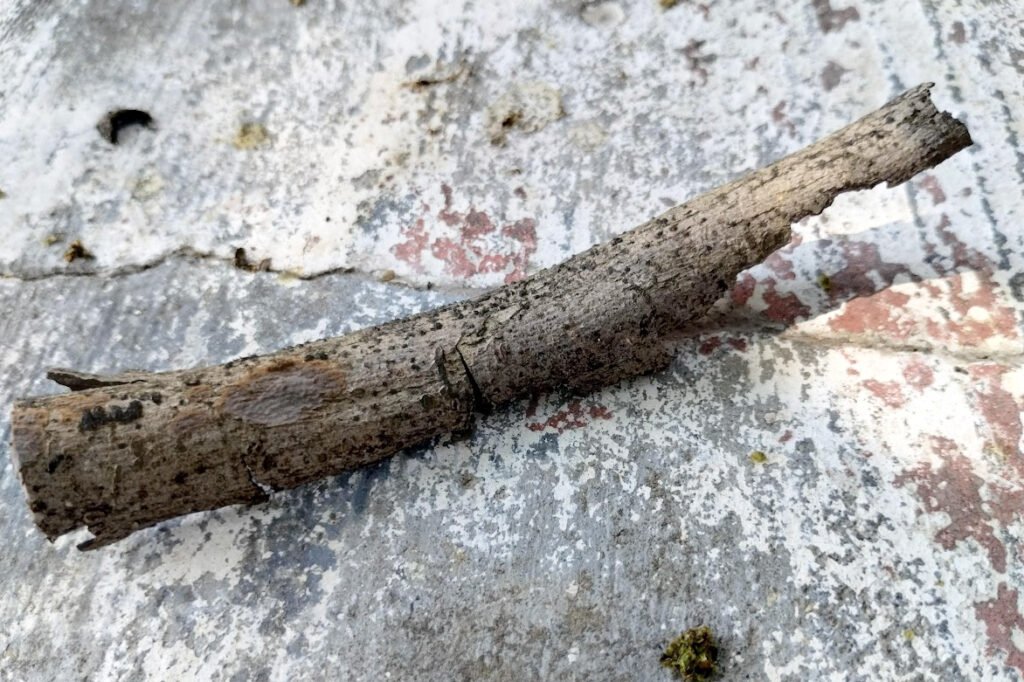
On the warm, sunny afternoon, when I inadvertently clicked this broken twig, I was not looking for a story. I merely took a picture.
It lay on a short ledge, stripped of its life, its bark weathered to a dull grey. Nothing about it was extraordinary. Had my stride been a tad brisk, or my gaze not so meandering, I would have left it behind unnoticed like so many other silent spectacles that never call for your attention. Looking at the picture later, I found a lot of character in the sliver of timber that looked surprisingly graceful in its passing. Deciding to post its picture on my photography blog Impressions, I began thinking of a caption and a phrase floated into my mind and got stuck — Driftwood on a Ledge.
It was an unseemly caption. It was no driftwood. It had never tumbled through foaming rapids, followed the course of a river, or surrendered itself to the ocean. It had merely chipped off a tree and got deposited on a crumbling ledge. Yet the longer I looked at the picture, feebler grew my conviction that the distinction really mattered.
Driftwood is romanticised for its extraordinary journey — Battered tree trunks travelling impossible distances from unknown places, silently riding perilous waves across vast open seas, before running ashore on unfamiliar beaches. Their loneliness is poetic for just how far they have drifted from home. The little twig had travelled no such distance. Perhaps it was lying only a few yards away from the tree that was once its home, indistinguishable amongst the thicket surrounding it. It was closer to home than any piece of driftwood could ever hope to be. Yet it was no less alone.
Distance has surprisingly little to do with loneliness and belonging. Some of the most lonesome people do not live thousands of miles away from their origins. They live among familiar faces in familiar places. There is a genre of human beings who epitomise driftwood. They have not drifted too far away physically, but emotionally they have no land in sight. Like nonchalant logs of wood, they ask for little from life and are often treated as inanimate objects. They listen because people have a pressing need to be heard. They care because people require support but are too proud to ask for it. They advise, solve problems, offer dependable shoulders and reliable hands and sometimes get appreciated for what they do… but rarely for what they are.
People return to them whenever they need comfort, and feel free to leave them behind once they feel ‘rested.’ Their kindness is expected and accepted without a word of acknowledgement. Some specimens suck the very sap out of driftwood people, while proclaiming they actually never care for that stuff in their lives. The kindness is never reciprocated because people do not pause to thank a piece of furniture, they use it and move along.
The reason such people become drifters is that nobody wants to hold on to them. They are not bad people, but they are often too much trouble. Like timber, they have an intrinsic stubbornness and integrity about them. They bend, but only slightly. Committed to their ideas of uprightness, they weather storms, get scarred, chipped, cut, and split wide open. They may get shaped into something gracious or grizzly depending on who hit them, how hard, and with how much dexterity; but they cannot be moulded to suit fickle whims and fancies like plastic. I guess they refuse to trade their authenticity for acceptance. This makes them useful. It does not make them belong. Most spend their lives looking for an anchor, or just to be claimed as someone’s own. While becoming repositories of other people’s emotional burdens, they are usually forced to carry their own baggage in total silence. Then comes a time when the twig snaps.
Resilience is often mistaken for invulnerability. It is easy to assume the twig never missed its tree simply because it did not wander off beyond the horizon holding onto its bleeding heart. It is also quite easy to assume that the tree never shed a tear for the twig because it was still standing there somewhere, looking at a piece of it withering away. I think of this as no less poetic than driftwood washed upon distant shores. The little twig lying on that ledge had not crossed oceans or survived hurricanes. It had merely detached from where it belonged. At times, that is voyage enough.
When I come across driftwood people in my life, I try to pause for a moment. They usually look kind of weathered but have a peculiarly strong sense of self-reliance. They often walk casually into a storm, and their pace hardly varies even if the heavens open up above them. They smile, never waiting to be smiled back at. I often feel they have looked at me before I meet their eyes. I make no claim to be adept at spotting all such incredible people, but from the conversations I have had during chance encounters, I think I have an affinity for them. Maybe that is what made me stop for the little twig. What caught my eye was not its brokenness, but the quiet dignity with which it continued to exist long after it had drifted away. I hope it rests in peace somewhere, and if there is any way universe can relay a message… you finally belong again — to a few megabytes on the World Wide Web, my gracious fellow drifter.
If this resonated, you may also like…
A Distillation of Pride
Why Every Life Is Pedestrian
All writings in Inklings are original works by Amit Pandey and remain with the author. Please do not reproduce complete posts or substantial portions without permission. Short quotations are welcome with attribution. For online references, please include:
© Amit Pandey. All rights reserved.

Another name for people like me, feeling alone in a crowd,gatherings.Driftwood .
Thank you for leaving a thought. I’m sure your own ideas make excellent company.